What is COIL?
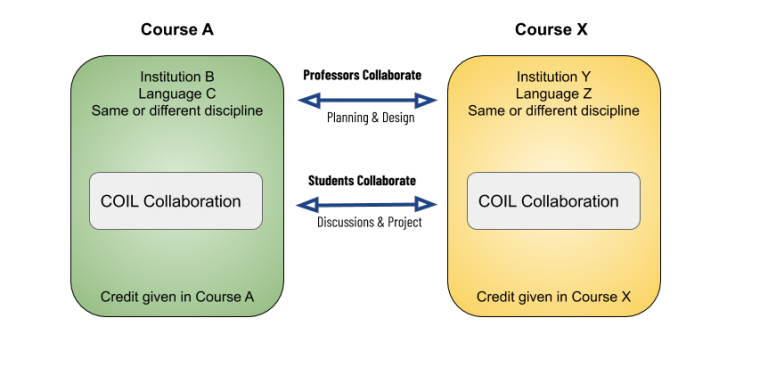
Collaborative Online International Learning (COIL) is an approach that brings students and professors together across cultures to learn, discuss and collaborate as part of their class. Professors partner to design the experience, and students partner to complete the activities designed. COIL becomes part of the class, enabling all students to have a significant intercultural experience within their course of study.
COIL:
- Can be created in any discipline; interdisciplinary collaborations work well
- Encourage active student learning and teamwork
- Include an emphasis on cross-cultural interactions and understanding
- Can be 5-15 weeks long
- Are a graded activity in each participating class
- Can use any technology tools that serves the learning goals
As part of an existing class, the COIL component can take place throughout the entire course, or, more commonly, as a module that lasts for several weeks during the course. The minimum recommended length for a COIL module is 5 weeks.
What are the components of a COIL module?
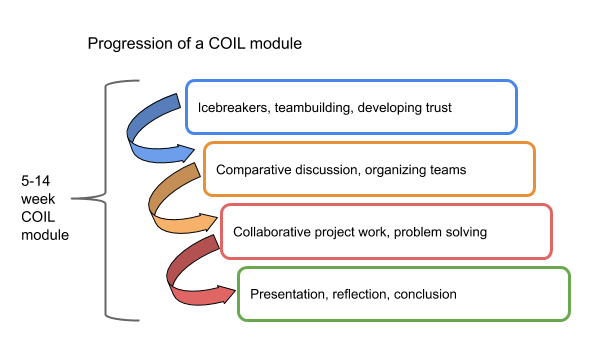
Effective COIL collaborations follow a recognized progression through specific phases.
- The team building phase includes introductions and icebreakers, along with discussions and activities designed to help students get to know and feel comfortable working with one another online and across cultures.
- The next phase includes comparative discussions and organizing the project that teams of students will be working on. This phase prepares students for effective collaborative project work.
- The project phase is focused on the main activity for the collaboration. This is the time that students apply their knowledge, create something together or have substantive discussions around the topic of the collaboration.
- The final phase involves the presentation of work completed (in any format agreed upon by the collaborating professors), reflection on both the content of the module and the intercultural aspects of the collaboration, and concluding.
How is a COIL module developed?
COIL planning begins with collaboration between professors from different institutions who want to bring intercultural and global learning into their classes.
Professors work together to:
- Define student learning goals
- Determine the length of the interaction
- Design comparative and collaborative activities
- Select methodology and technology tools for collaboration
- Monitor student work and learning
Students work together to:
- Develop effective international/intercultural teams
- Discuss course assignments and content
- Complete a project-based activity as part of their coursework
- Reflect on both the academic content of the course and the intercultural exchange that takes place
There are many aspects that need to be discussed when developing a COIL module, such as language use, timing and calendars, harmonizing COIL module learning goals with overall course objectives, methods of assessment, classroom management issues, and technology tool selection. If you are interested in developing a COIL module for one of your classes and would like training and support on how to do this, the SUNY COIL Center has a number of professional development offerings that can help you.
Sample COIL Syllabi
International Joint Venture COIL outline
Collaborating and Educating in English through Digital Media
Successful Veterinary Business
Cultural Influences on Management Styles
Cross Cultural Storytelling through Media
Perspectives on COIL
Student Perspectives
“It shrinks the globe for you. Now I might take the chance and study abroad because I know someone from overseas.”
“I would love to have at least one COIL class every semester. It really changed my whole academic experience and my personal life. I’ve been so eager to have that experience again… It really broadened my horizons.”
“I would definitely do this again given the opportunity because this is great for people like me who kind of just stick to their circle and don’t really branch out and talk to new people, I think that’s important but I don’t do it enough. I learned to not be so shy and just speak up.”
“I feel that doing this course collaboratively with our international partners really added a more hands on experience to our class. It is one thing to just talk about how to use online marketing in class, but this course required that we take what we learned and apply it.”
Instructor Perspectives
“My COIL work has been transformative to my teaching and scholarship. My COIL partnership has added depth and dimension to the curriculum and my teaching has become more active and intersectional.
“COIL has not only internationalized my curriculum, but it has internationalized my teaching methods as well. Thanks to my COIL experiences, I have been able to learn new classroom activities from my international teaching partners.”
“COIL = connecting for a purpose, virtual exchange matters”
Intercultural Learning
Supporting the development of intercultural competence is an important aspect of COIL collaborations. For many students, a COIL collaboration is the first opportunity they have to engage with peers from another country. It is likely that students have engaged with people from other cultural backgrounds in their home communities, but most students have not been asked to reflect on cultural differences at home, therefore, COIL is frequently the first intentional intercultural communication activity they will undertake.
Eva Haug from the Amsterdam University of Applied Sciences in the Netherlands explains the concept of culture.
Cultural awareness and cultural competencies are essential in today’s world. Modern societies, groups and organizations are becoming increasingly multicultural, where people from different cultural backgrounds live and work together. Our understanding of culture depends on many factors, including our own worldview, academic background, and experiences. Technology makes it possible for people in different places in the world to meet and share online.
Globalization – characterized by increasing interconnections and integration between economies, nations, businesses and societies – has an impact on the context in which most people live and work. Globalization is accelerated through information and communication technologies such as special interest websites, social media, messaging apps, videos, and conferencing systems. These technologies have given rise to networks and communities involving individuals from a diverse range of cultural backgrounds who share common interests and purposes.
Helping students develop intercultural competence (skills that facilitate effective and appropriate interactions with people from other cultures) is important for 21st century higher education. COIL represents an effective approach to developing these skills through intentional online academic collaboration with peers around the world.
